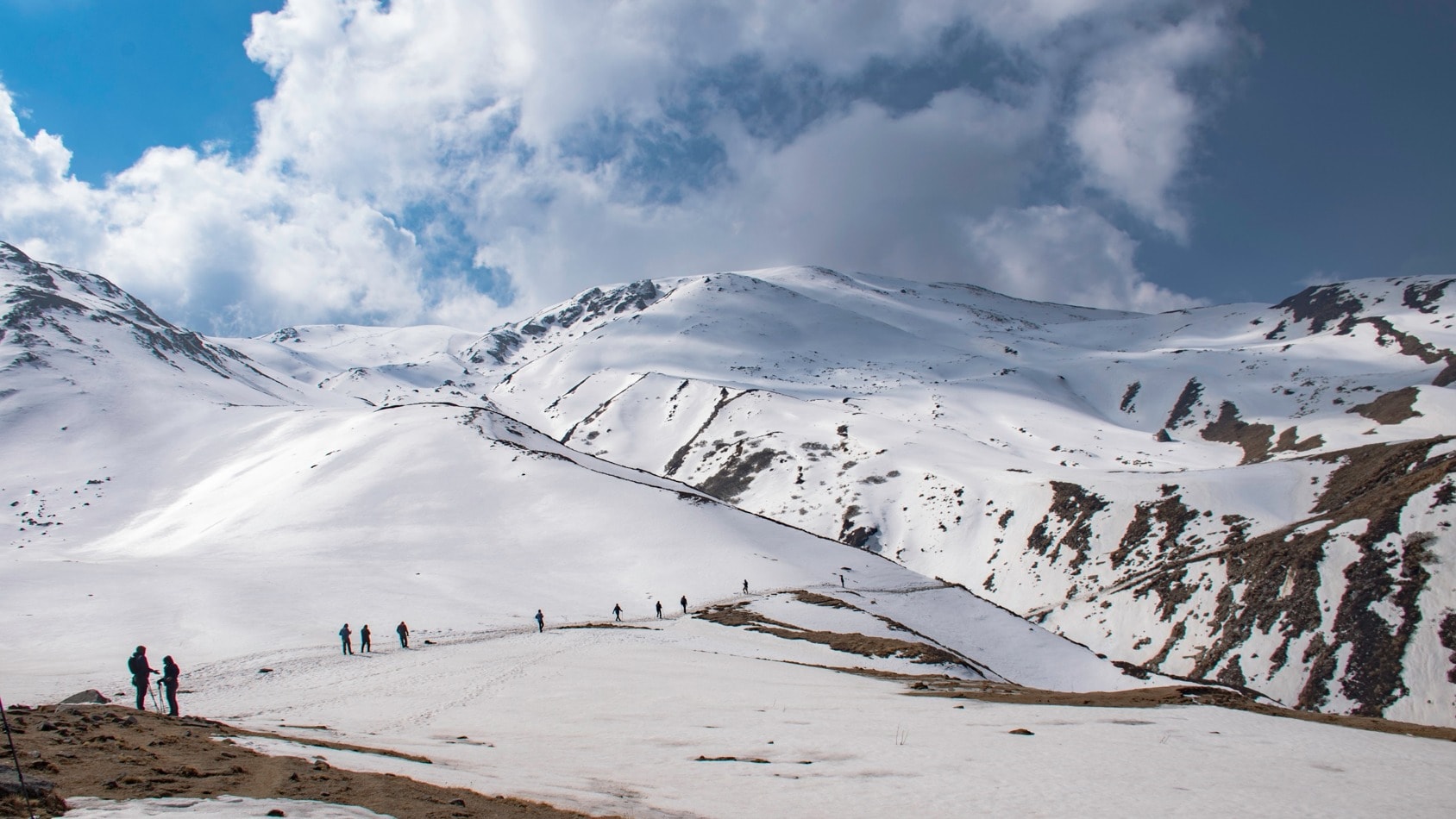
Kuari Pass gets billed as an easy beginner trek — it mostly is, but the season you pick changes the experience completely. Here's the honest route, permits and timing.
In this article
- The route: Joshimath to the pass
- Winter (December-March) vs autumn/spring: pick your trek
- Difficulty: genuinely a good first trek, with caveats
- Permits and practicalities
- Frequently asked questions
- Is Kuari Pass trek good for beginners?
- What is the best time for Kuari Pass trek?
- How difficult is the Kuari Pass trek?
- Do I need a permit for Kuari Pass?
- Can I combine Kuari Pass with Pangarchulla Peak?
- Trek Kuari Pass with us
Kuari Pass Trek: Honest Difficulty, the Joshimath Route and Best Time to Go
Kuari Pass gets recommended as "the" first Himalayan trek for a reason — the gradient is genuinely forgiving, the views of Nanda Devi are absurd for the effort involved, and the route follows the Lord Curzon Trail through oak and rhododendron forest that doesn't demand technical skill. What most listicles skip is that Kuari Pass in December snow and Kuari Pass in October sunshine are close to two different treks. Which one you book should depend on what you actually want out of it.
The route: Joshimath to the pass
You'll base out of Joshimath (around 1,875m, in Chamoli district), then drive roughly 12-15km to Dhak village, where the actual trekking starts. From Dhak, the trail climbs through thick oak and rhododendron forest to Gulling or Tali campsite, then opens out into the Gorson bugyal — a rolling alpine meadow that's one of the trek's genuine highlights regardless of season — before the final push to the pass itself, sitting at roughly 3,800m (figures across operators range from about 3,800m to just over 3,900m depending on exactly which high point is measured). Total distance runs 18-22km depending on the exact itinerary and whether Gorson Bugyal or Pangarchulla is included as an add-on, typically over 5-6 days including acclimatisation and buffer.
Winter (December-March) vs autumn/spring: pick your trek
Indiahikes, one of the more experience-first sources on this trail, points out that Kuari Pass actually stays walkable for close to nine months of the year — everything except the monsoon months of July, August and early September, when the trail turns to slush and visibility drops. That's a genuinely different picture from how most operators market it, which is almost entirely as a winter snow-trek. Both framings are honest, just for different treks: December through March gets you knee-to-thigh-deep snow past Gulling, technical use of microspikes on the final pass approach, and the postcard-white Gorson meadow — but also shorter days and colder camps. Early-to-mid December specifically tends to be the sweet spot within that window, with the first clean snow down but before peak-winter cold sets in. October-November and April-May, by contrast, give you clearer trails, easier footing, and often better long-range visibility toward Nanda Devi and Dronagiri, without the technical snow travel. If you've never used microspikes or walked on packed snow before, autumn is the more forgiving choice; if the reason you're doing this trek is the snow photos, winter is non-negotiable.
Difficulty: genuinely a good first trek, with caveats
The gradient is moderate throughout — there's no single brutal summit push the way there is on, say, Brahmatal's final climb — which is why it's consistently recommended for first-timers. The caveats: altitude still matters at 3,800m, so don't skip the acclimatisation day even though the trail feels easy; the descent from Gulling through the forest gets genuinely slippery in winter where packed snow turns to ice on shaded sections; and if your itinerary extends to Pangarchulla Peak as an add-on, that's a different proposition entirely — Pangarchulla climbs to around 4,550-4,600m with real scrambling and AMS risk, not a casual extension.
Permits and practicalities
The trail runs through reserved forest and, on some route variants, the buffer zone of the Nanda Devi Biosphere Reserve, so a forest department permit is mandatory — this is normally arranged by your trek operator through the Joshimath forest office, but carry a government photo ID regardless, since it's checked at the entry point. Mobile network is patchy to absent past Dhak, so tell someone your itinerary before you lose signal, and don't count on calling for help beyond basic BSNL patches at higher camps.
Frequently asked questions
Is Kuari Pass trek good for beginners?
Yes — it's one of the more commonly recommended first Himalayan treks because of its moderate, non-technical gradient, though winter ascents do require basic snow-walking comfort.
What is the best time for Kuari Pass trek?
Early-to-mid December for the classic snow-trek experience with manageable cold, or October-November/April-May if you'd rather skip technical snow sections and prioritise clear long-range views.
How difficult is the Kuari Pass trek?
Moderate. The gradient is gentle compared to most Himalayan treks, but altitude (up to ~3,800m) and icy sections in winter still require care and basic fitness.
Do I need a permit for Kuari Pass?
Yes, a forest department permit is required and is typically arranged by your trek operator through the Joshimath office. Carry a valid government photo ID.
Can I combine Kuari Pass with Pangarchulla Peak?
You can, but treat it as a separate, harder trek — Pangarchulla involves real scrambling near 4,550-4,600m and carries meaningfully higher AMS risk than Kuari Pass alone.
Trek Kuari Pass with us
We run this as a small-group experience out of Joshimath. Check out our Kuari Pass trek, or if you want a different winter trek entirely, see our Brahmatal trek. Browse everything we run on our trips page.
Wondrr Team
Travel Curators