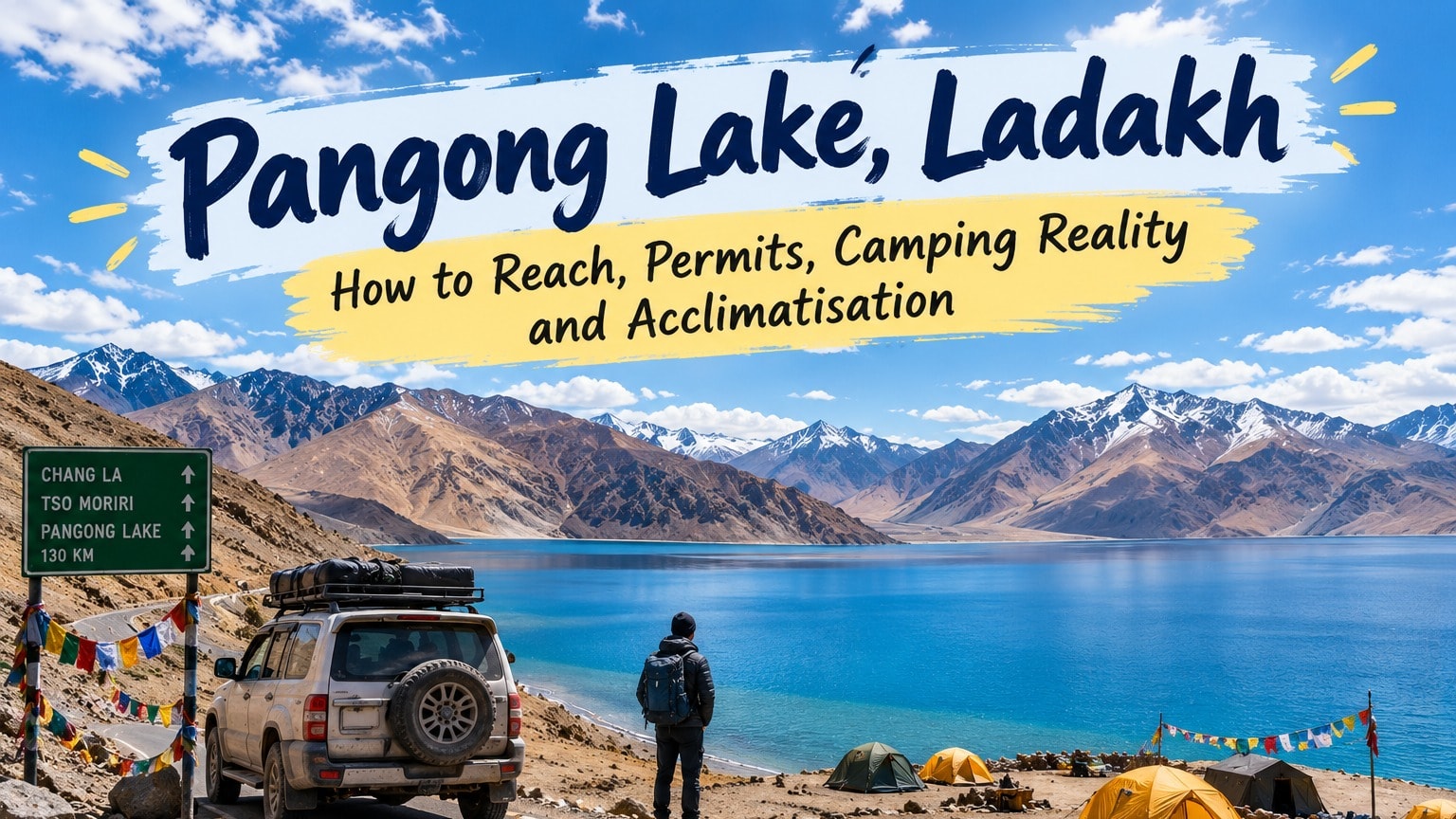
Everything the postcard photos leave out about Pangong Tso: the Chang La acclimatisation trap, the honest camping-ban situation at the shoreline, permits, and when to go.
In this article
- Getting there from Leh
- The acclimatisation mistake almost everyone makes
- Where you can actually camp — and the honest legal picture
- Best time to visit
- Pangong or Tso Moriri?
- Frequently asked questions
- What permit do I need for Pangong Lake?
- Can you camp right on the Pangong Lake shoreline?
- How do I avoid altitude sickness on the way to Pangong?
- How far is Pangong Lake from Leh?
- What's the best time to visit Pangong Lake?
- Should I visit Pangong or Tso Moriri first?
Pangong Tso is the lake everyone's seen a hundred photos of before they ever set foot in Ladakh — that impossible gradient of blue against bare brown mountains. What most of those photos don't show is the two things that actually decide whether your visit goes well: how you pace the altitude on the way there, and where you're actually allowed to camp once you arrive. Both get glossed over constantly, so here's the honest version.
Getting there from Leh
The standard route runs Leh - Karu - Sakti - Chang La - Tangtse - Lukung - Spangmik, roughly 160km and 5-6 hours of driving. Chang La itself sits at 5,360m, one of the highest motorable passes anywhere, and the road is mostly paved with some genuinely rough patches near the pass and after Tangtse. There's also a longer route in via Nubra Valley, around 230km and 8-9 hours, which some travellers use to link the two regions into one loop rather than two separate day trips from Leh.
Every Indian traveller needs an Inner Line Permit for this route, applied for online (the Leh district portal is the reliable option) for a nominal fee, and it's worth printing a few photocopies since you'll show it at more than one checkpoint. Foreign nationals need a Protected Area Permit instead, arranged through a registered Leh travel agent — it isn't something you can sort out yourself online, so build a day or two of lead time into your plans if you're travelling on a foreign passport.
The acclimatisation mistake almost everyone makes
Pangong sits at 4,350m, which is already higher than most travellers expect, but the real risk isn't the lake — it's Chang La on the way there. At 5,360m, crossing that pass on your first or second day in Ladakh, before your body has adjusted to Leh's own 3,500m, is exactly how people end up with a splitting headache and nausea that ruins the one day they'd built the whole trip around. Spend two to three full days acclimatising in Leh first — short walks, plenty of water, no alcohol — before you attempt Chang La. It costs you a day of your itinerary. It buys you a Pangong visit you'll actually enjoy instead of one you spend lying down in a tent.
Where you can actually camp — and the honest legal picture
This is the detail most guides get wrong or leave out entirely: camping right on the Pangong shoreline is not just discouraged, it's been the subject of a court-ordered removal of lakeside structures, aimed at illegal, unpermitted camps degrading a genuinely fragile ecosystem. In practice, enforcement has been inconsistent, and you'll still find operators running camps near Spangmik, Man and Merak villages a short distance back from the water. We'd treat that as a grey area rather than a green light — book through an established, registered operator rather than an ad-hoc setup, and don't be surprised if the rules tighten further by the time you travel. If you'd rather not gamble on it, the more dependable options are a homestay in one of those same villages, or a hotel base in Durbuk or Tangtse, 30-40km back down the road, with Pangong as a day trip.
Best time to visit
July to September is peak season and for good reason — the water is at its most vivid blue and conditions are the most reliable for the drive. May and June get you there earlier with noticeably fewer people around, though the lake can still carry a chill in the mornings. October is still accessible and increasingly quiet, but nights turn properly cold. From November through April the lake freezes and most camps shut for the season.
Pangong or Tso Moriri?
If you're trying to choose between Ladakh's two big high-altitude lakes: Pangong is closer to Leh, easier to combine with a Nubra Valley loop, and busier because of it. Tso Moriri sits higher, further south, and gets a fraction of the crowds — worth considering if quiet matters more to you than convenience. Our Ladakh bike trip via Hanle and Ladakh bike trip via Tso Moriri both route through this part of Ladakh, so take a look at which itinerary fits the pace and scenery you're after — or browse the rest of our departures on our trips page.
Frequently asked questions
What permit do I need for Pangong Lake?
Indian nationals need an Inner Line Permit, applied for online through the Leh district portal. Foreign nationals need a Protected Area Permit, arranged through a registered Leh travel agent in advance.
Can you camp right on the Pangong Lake shoreline?
Officially, no — a court order requires structures right on the shoreline to be removed, though enforcement has been inconsistent and some camps still operate near Spangmik, Man and Merak villages. Book through a registered operator, or use a village homestay or a Durbuk/Tangtse hotel base if you'd rather not rely on a camp that may not be there next season.
How do I avoid altitude sickness on the way to Pangong?
Spend two to three days acclimatising in Leh before attempting Chang La (5,360m) — the pass, not the lake itself, is where most altitude problems actually happen.
How far is Pangong Lake from Leh?
About 160km via Chang La, roughly 5-6 hours of driving. A longer alternative via Nubra Valley covers about 230km and 8-9 hours.
What's the best time to visit Pangong Lake?
July-September for the most vivid water and reliable road conditions. May-June works well for smaller crowds, and camps generally close from November through April as the lake freezes.
Should I visit Pangong or Tso Moriri first?
Pangong is closer to Leh and pairs naturally with Nubra Valley; Tso Moriri sits higher and further out but is noticeably quieter. Both are worth doing if your itinerary allows it.
Pangong is worth every bit of its reputation — just give Chang La the respect it deserves before you chase that first photo of the water.
Wondrr Team
Travel Curators