The two highways into Ladakh are not interchangeable. The order you ride them decides how your body handles the altitude — here's the operator's reasoning.
In this article
- It is not "which road is better" — it is "which one first"
- The two roads, honestly compared
- Srinagar to Leh
- Manali to Leh
- Why the direction matters so much
- When you cannot do both
- Season and conditions
- Frequently asked questions
- How many days do I need to do both routes?
- Which route is more scenic?
- Is Zoji La as bad as people say?
- Can I do this in a regular car?
- What if I start feeling unwell?
- Get the order right
It is not "which road is better" — it is "which one first"
Almost every comparison of these two highways frames it as a choice: pick Srinagar or pick Manali. That framing is the problem. If you have the days, the right answer for most first-timers is both — and the thing that actually determines how your trip goes is the order you ride them in.
We plan Ladakh trips around this constantly, and the pattern is consistent enough to be predictable. Groups that go up via Srinagar arrive in Leh in decent shape. Groups that go up via Manali often lose a day or two to headaches and nausea somewhere around Sarchu, and a few people never quite recover their appetite for the rest of the trip. Same riders, same bikes, same weather. Different altitude profile.
The two roads, honestly compared
Srinagar to Leh
Roughly 420 km. The gentler of the two by a considerable margin. You climb gradually out of the Kashmir valley, over Zoji La, into Drass and Kargil, and on through Lamayuru to Leh. The highest point you cross is Fotu La at around 13,478 ft.
Crucially, this road has people on it. Kargil is a proper town with hotels, food, fuel and a hospital. There are villages, army posts and dhabas at sensible intervals. If something goes wrong — mechanical, medical, weather — you have options. Most people split it over two days with a night at Kargil, which also happens to be an excellent altitude staircase: sleep at moderate height, then climb.
Manali to Leh
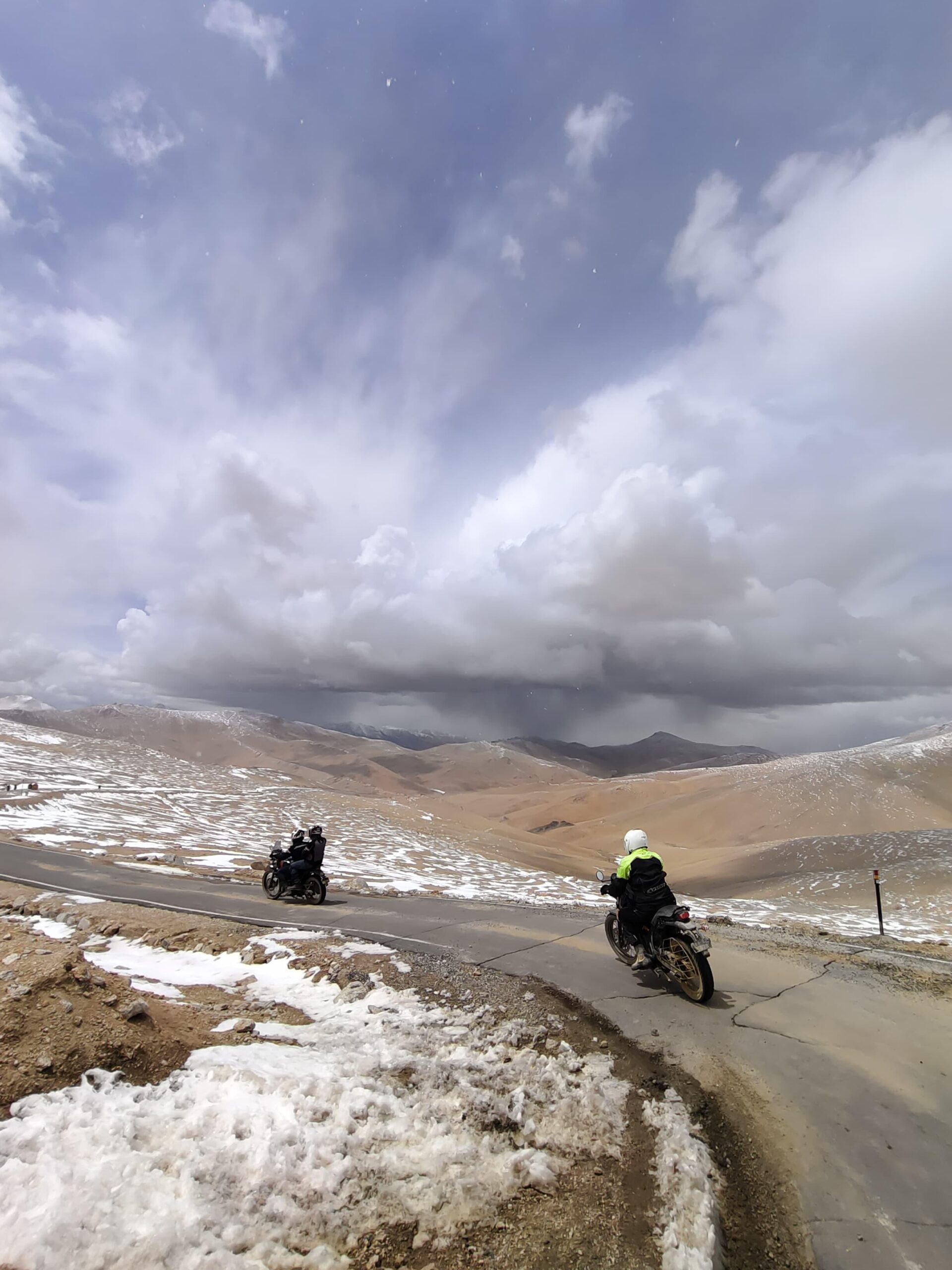
Roughly 470 to 490 km depending on whose measurement you take. This is the spectacular one, and also the harder one. Beyond Keylong you are into genuinely remote country — the Gata Loops, the More Plains, and Tanglang La at around 17,480 ft, which is nearly 4,000 ft higher than anything on the Srinagar side.
The real issue is not the passes themselves; it is where you sleep. The natural overnight halts on this route, Sarchu and Pang, both sit very high. Sleeping at that altitude on your second or third day out of the plains, before your body has adapted, is what generates the misery. Tented camps at Sarchu are a rite of passage and also, medically speaking, a fairly aggressive thing to do to an unacclimatised body.
Why the direction matters so much
Altitude adaptation is about the height you sleep at, and how quickly you raise it. Ride Srinagar to Leh and your sleeping altitudes rise in reasonable steps — Sonamarg or Kargil, then Leh — with the highest pass crossed during the day and descended from before nightfall. That is textbook. By the time you reach Leh you have already banked several nights of gradual adaptation.
Now flip it. Manali to Leh asks you to jump from around 2,000 m to a high-altitude camp within a day or two, cross a 17,000 ft pass, and only then arrive. You are doing the hardest altitude work at the point when you are least prepared for it.
So the sequence we recommend is: up via Srinagar, a few days around Leh, out via Manali. By the time you ride Tanglang La southbound you are thoroughly acclimatised and descending towards thicker air, which makes the same road a pleasure rather than a trial. You also get both highways in one trip, which is the honest reason to do it this way.
Whichever direction you choose, give Leh itself proper time before heading anywhere higher — the Changthang and the high passes deserve their own rest days built in. Both our Ladakh itineraries, the route via Hanle and the route via Tso Moriri, are sequenced with that in mind rather than built to maximise kilometres.
When you cannot do both
Plenty of people have a week, not two. If you must pick one:
Choose Srinagar if it is your first time at altitude, if you are travelling with family or anyone with health considerations, if you want a safety margin, or if you would rather the road not be the hardest part of the holiday. It is also the better call if you are driving a car rather than riding.
Choose Manali if you have been to altitude before and know how your body responds, if remoteness is the point, and if you can build in acclimatisation days rather than charging through. Some riders break the journey with a night at Jispa instead of Sarchu, which is meaningfully lower and a much kinder place to sleep — that single change fixes a lot of what goes wrong on this route.
The alternative many people overlook: fly into Leh, rest two full days, and ride out. It costs you the approach but it is far safer than a compressed Manali run, and it works well on a short schedule.
Season and conditions
Both highways are seasonal. They typically open somewhere between late May and June and close around October, and the exact dates move every year with the snowfall — neither is a fixed calendar. The Srinagar side generally opens a little earlier and stays open a little later. Always check current road status before committing to dates, and build a buffer day in; closures for weather or clearing work are routine.
Travel advisories and local conditions on the Kashmir side can also change, so check the current position before finalising a Srinagar approach. Whichever way you go, carry warm gear well beyond what the season suggests, keep fuel topped up, and do not plan to ride after dark.
Frequently asked questions
How many days do I need to do both routes?
Ten to twelve days is comfortable for Srinagar in, time around Leh, and Manali out. Less than that and you are cutting the rest days that make the whole plan work.
Which route is more scenic?
Manali, for most people — the moonscape beyond Sarchu is unlike anything else. Srinagar is greener and more varied, with Lamayuru a real highlight. It is a genuine matter of taste.
Is Zoji La as bad as people say?
It can be rough and it is often congested with trucks, but it is short and it is the price of an otherwise gentle route. Cross it early in the day.
Can I do this in a regular car?
The Srinagar route, yes, with reasonable ground clearance and a careful driver. The Manali route has water crossings that make a higher-clearance vehicle strongly advisable.
What if I start feeling unwell?
Stop ascending. If symptoms persist or worsen, descend — that is the only reliable treatment. Do not push on to reach a booked camp.
Get the order right
The passes, the plains and the photographs are the same whichever way round you ride them. What changes is whether you enjoy them. Ride in via Srinagar, take your time in Leh, and come home over Tanglang La. If you would rather have the sequencing, permits and stays handled, have a look at our Ladakh trips — we build them in this order for exactly the reasons above. Road status and advisories change season to season, so confirm before you book travel.
Wondrr Team
Travel Curators