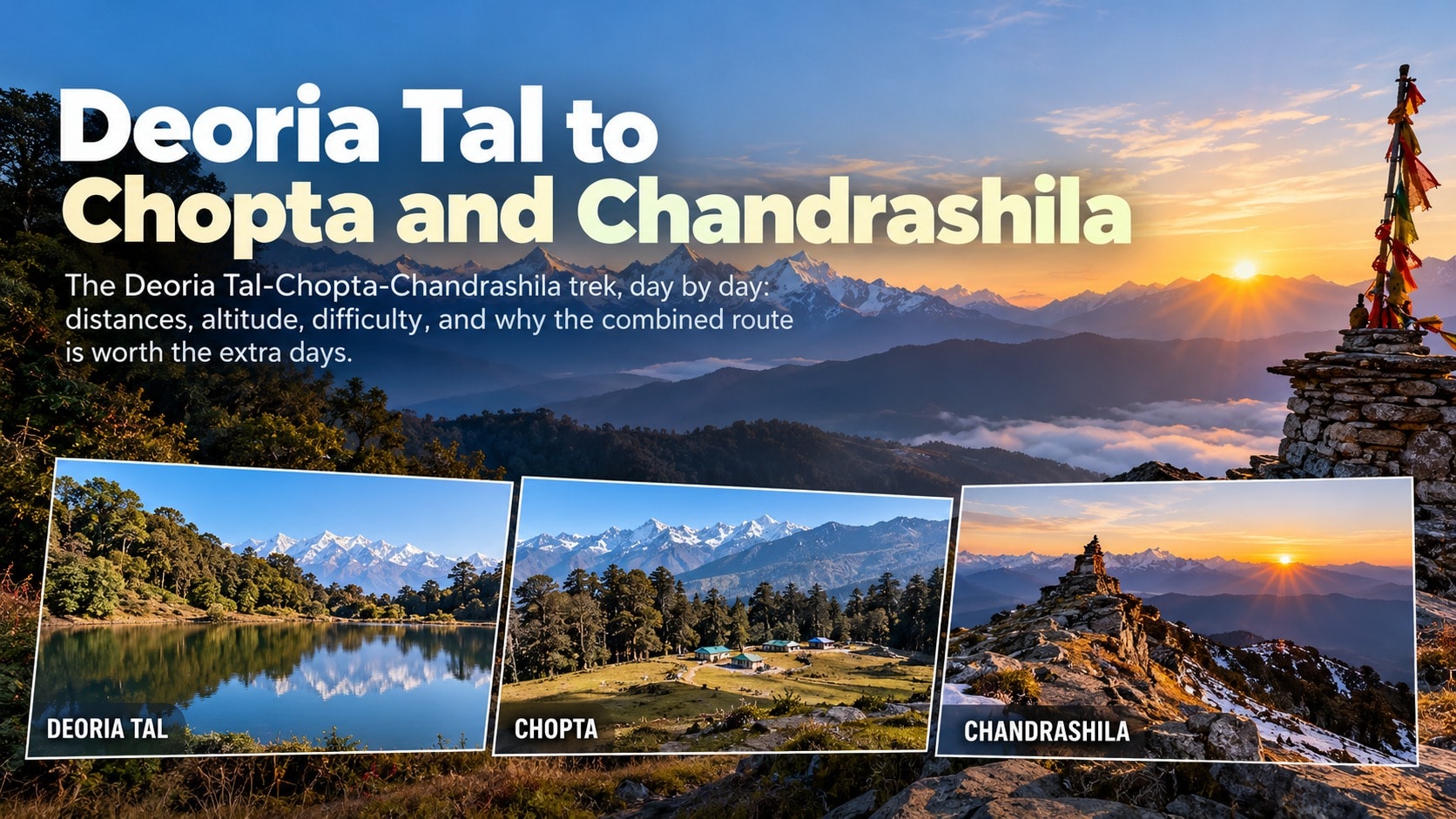
The Deoria Tal-Chopta-Chandrashila trek, day by day: distances, altitude, difficulty, and why the combined route is worth the extra days.
In this article
Why Combine Deoria Tal, Chopta and Chandrashila
Most people do one of these three as a standalone trip: a short overnight to Deoria Tal for the lake and its mirror reflection of Chaukhamba, a day hike from Chopta up to Tungnath and Chandrashila, or Chopta on its own as a base for the Chandrashila summit. Combined into one multi-day route, they stop being three separate short trips and become one genuinely satisfying trek — gentle lake-and-meadow walking for the first stretch, building to a real summit push at the end. Here's how the combined route actually lays out, and what each day demands.
The Route, Day by Day
- Day 1 — Drive in, Sari village. Most trekkers base out of Dehradun or Rishikesh, with the drive to Sari village running around 220-230 km, a long day on the road that's worth doing the day before you start walking rather than squeezing in on trek day one.
- Day 2 — Sari to Deoria Tal. A short, gentle 2.5-3.5 km trek gets you to Deoria Tal, sitting at roughly 2,400-2,450 m (around 7,900-8,000 ft). This is an easy half-day climb through forest, and most groups camp at the lake overnight — the early morning reflection of the Chaukhamba range on the water is the reason people make the detour here at all.
- Day 3 — Deoria Tal to Chopta, via Rohini Bugyal. This is the longest walking day of the trek, around 15-16 km through alpine meadows (bugyals), and genuinely the most scenic stretch of the whole route — wide open grassland with Himalayan peaks on the skyline for most of the walk.
- Day 4 — Chopta to Tungnath to Chandrashila, and back to Chopta. From Chopta it's roughly 4-4.5 km to Tungnath — the highest Shiva temple in the world, at about 3,680 m — then a steeper 1.5-2 km push to the Chandrashila summit at roughly 3,680-3,700 m (around 12,080-12,140 ft). This is the hardest single day: a real altitude gain in a short distance, usually tackled as a pre-dawn start so you catch sunrise from the summit before the clouds roll in.
- Day 5 — Chopta to Dehradun. The return drive mirrors day one, roughly 200-210 km back to Dehradun.
Total trekking distance across the route runs approximately 27-28 km over the walking days, making this a genuinely moderate trek rather than an easy one — the Deoria Tal and Rohini Bugyal stretches are gentle, but the Chandrashila summit day asks for real fitness and, ideally, a trek or two of prior experience.
Difficulty and Who This Trek Suits
This sits in the easy-to-moderate band: nobody needs technical climbing experience, but the Chandrashila summit push is a genuine test, especially if there's fresh snow on the final stretch (which happens outside the main season). First-time trekkers do manage this route, but it rewards some prior cardio fitness and at least one shorter trek under your belt — it's a reasonable step up from something like Triund, not a true beginner's first trek.
Best Season — and Why It Actually Matters Here
Spring (roughly March through June) and autumn (September through November) give you the clearest Chandrashila summit views and the most reliable trail conditions. Outside those windows, snow can make the final Tungnath-to-Chandrashila stretch considerably harder and occasionally unsafe without the right gear — if you're trekking in the shoulder season either side of winter, check current trail and snow conditions with your trek operator rather than assuming the route is open as described. Monsoon months (July-August) bring leeches and slippery meadow trails on the Rohini Bugyal stretch and are generally best avoided for this particular route.
What Makes This Route Worth the Extra Days
Doing Chopta-Chandrashila alone gets you the summit but skips the two things that make this combined route distinctive: Deoria Tal's lake-and-reflection morning, and the long bugyal walk between Deoria Tal and Chopta, which is arguably more memorable than either endpoint. If your schedule only allows a shorter trip, a standalone Chopta-to-Tungnath day hike or a dedicated Chandrashila push are both legitimate shorter alternatives — just know you're trading the meadow stretch and the lake for a faster trip.
Frequently Asked Questions
How many days does the Deoria Tal-Chopta-Chandrashila trek take?
Typically 5 days including drive-in and drive-out from Dehradun, with 3 full trekking days in between.
What's the altitude of Chandrashila summit?
Roughly 3,680-3,700 m (around 12,080-12,140 ft) — sources vary slightly on the exact figure, but it sits in that range.
Is this trek suitable for beginners?
It's manageable for a fit first-timer, but the Chandrashila summit day is a genuine step up in difficulty from an easy trek like Triund. Some prior trekking experience helps.
Can I skip Deoria Tal and just do Chopta to Chandrashila?
Yes, as a shorter standalone trip — but you'll miss the alpine meadow walk through Rohini Bugyal, which is one of the most scenic stretches of the full route.
What's the best time of year for this trek?
Spring (March-June) and autumn (September-November), when trails are clearest and the summit push isn't complicated by fresh snow. Check current conditions if trekking just outside this window.
We run this as a full combined route on our Deoria Tal-Chopta-Chandrashila trek. If you'd rather do a shorter version, our Chopta-Tungnath trek and Chopta-Chandrashila trek both cover the summit push without the full multi-day meadow route. Browse all our upcoming treks for other Uttarakhand options.
Wondrr Team
Travel Curators