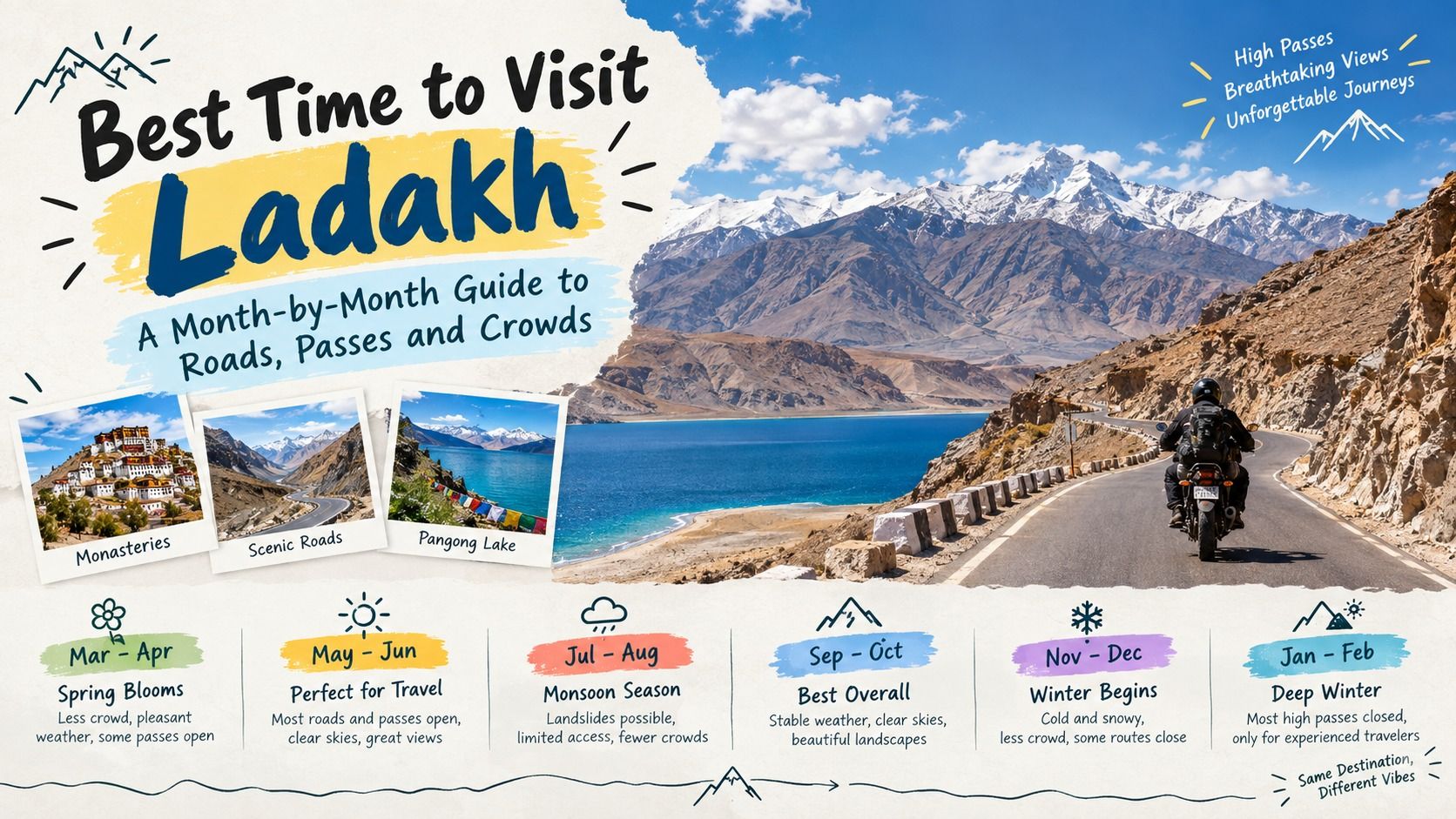
Ladakh's roads don't run on one "summer season" — here's when the Manali and Srinagar highways actually open, and the specific weeks worth planning around.
In this article
- The real question isn't "which season" — it's which three weeks
- April: Leh is open, but only from one side
- May: the road opens, the crowds haven't arrived yet
- June to August: everything is open, and so is everyone's calendar
- September and early October: our pick, and here's why
- The Atal Tunnel changed part of the story — not all of it
- November to March: flights only, and a genuinely different trip
- Our honest recommendation by traveller type
- A quick word on permits
- Frequently asked questions
- What is the single best month to visit Ladakh?
- Can I visit Ladakh in winter without doing the Chadar trek?
- Which opens first, the Manali or the Srinagar route?
- Is it cheaper to visit in September than in July?
- Do I need to worry about altitude regardless of when I go?
- Plan around the road, not just the calendar
The real question isn't "which season" — it's which three weeks
Almost every article on this topic tells you the same thing: go between June and September. That's not wrong, but it's not especially useful either, because "June to September" is four months and Ladakh changes meaningfully from one end of that window to the other. We run trips into Ladakh every season the roads allow it, and the honest answer depends on what you actually want — empty roads, wildflowers, the best photography light, or the lowest flight prices — because you cannot have all of them in the same week.
Here's the month-by-month version, built around what the roads and passes are actually doing, not just what the weather app says.
April: Leh is open, but only from one side
The Srinagar-Leh highway is usually the first to reopen after winter, typically by mid-to-late April, while the Manali-Leh highway is still shut under snow. If you fly into Leh this early — and flying is really the only sensible option in April — you'll find the town itself waking up, daytime temperatures in the low-to-mid teens, and nights still well below freezing at altitude. Some high monasteries and the more remote valleys (Nubra, anything near Pangong or Tso Moriri) may still be difficult or restricted. This is a niche window for travellers chasing quiet, apricot-blossom photography in Ladakh's lower villages, not for a full circuit.
May: the road opens, the crowds haven't arrived yet
This is where it gets interesting. The Manali-Leh highway is typically cleared by BRO end-to-end by mid-May, with full two-way civilian traffic usually confirmed over the following two to three weeks — the exact date shifts year to year depending on how heavy that winter's snowfall was, so treat "mid-to-late May" as the realistic window rather than a fixed date. Early May can still catch you on the wrong side of a closure; by the second half of the month, both approach roads are usually functioning. Daytime temperatures climb into the pleasant range, wildflowers start appearing in the lower valleys, and — this is the part worth knowing — crowds are still thin because most of India's travel calendar hasn't caught up to the fact that the roads are open. If your dates are flexible, late May is one of the best-kept-secret windows of the year.
June to August: everything is open, and so is everyone's calendar
By June both highways are fully functional and every high pass on the standard circuit — Baralacha La, Nakee La, Lachulung La, Tanglang La on the Manali side, Zoji La on the Srinagar side — is clear. This is peak season, and it's peak for a reason: reliable weather, every guesthouse and homestay open, every route accessible. It's also when Ladakh is busiest and most expensive, particularly through the July-August school holiday stretch. If you're set on riding to Umling La, Khardung La or doing the full Pangong-Nubra-Tso Moriri loop in one trip, this is the safest window for road conditions — just book your permits, homestays and fuel stops well ahead, because everyone else has the same idea.
One genuine caveat for August specifically: this is also when Ladakh sees its (limited) rainfall, and cloudbursts, though rare, have caused real damage to roads in this region in past years. It rarely derails a trip, but it's worth building a spare day into any August itinerary rather than running back-to-back transfers with a flight booked for the same evening.
September and early October: our pick, and here's why
If you ask us which weeks we'd send a first-time visitor, it's the back half of September into the first ten days of October. The passes are still open, the summer crowds have thinned out considerably, hotel and homestay rates soften, and the light goes from flat summer glare to something genuinely dramatic — locals call it the season when the valley turns gold, and it's not an exaggeration once the poplar and willow lines start turning. It's also, for what it's worth, the best stretch of the year for stargazing: skies are at their clearest, and if your route takes you through Hanle's dark-sky reserve, September and early October are when that detour earns its place on the itinerary.
The trade-off is that you're now racing the calendar. Both highways typically start closing in late October, and the closure date isn't fixed — it depends on the first serious snowfall over the highest passes, which BRO decides on the ground rather than by a schedule. Build in slack if you're travelling in the second half of October, and don't assume the road will still be open just because it was last year on the same date.
The Atal Tunnel changed part of the story — not all of it
A lot of older articles on this topic still talk about Rohtang Pass as the seasonal bottleneck on the Manali route. That's outdated. The Atal Tunnel now bypasses Rohtang entirely and runs 24/7, effectively year-round, which means the Manali side of Himachal is connected to Lahaul through most of the winter. What this doesn't do is open the road to Leh. Beyond the tunnel, you're still climbing to Baralacha La and the other high passes on the Manali-Leh highway, and those close under snow exactly as they always did. Don't let "the tunnel is open" get confused with "the road to Ladakh is open" — they're different questions, and conflating them is the single most common planning mistake we see in enquiries between November and April.
November to March: flights only, and a genuinely different trip
Both highways close for winter, typically from some point in November until the Manali side reopens in May and the Srinagar side a few weeks earlier. The only way into Leh in this window is by air. What you get in exchange is a completely different Ladakh: frozen monasteries, near-empty streets, and — for a narrow window in January and February — the possibility of the Chadar trek, walking on the frozen Zanskar river through its gorge. This is a serious, cold-weather undertaking (expect nights well below -20°C) and not a casual add-on to a winter sightseeing trip; it needs its own planning and an operator experienced in that specific route.
Our honest recommendation by traveller type
If you want the fullest circuit with the least road-condition risk: July or the first half of August. If you want the same circuit with better light and thinner crowds, and you're comfortable with slightly more schedule risk at the tail end: late September into early October. If you're chasing value and don't mind a shorter, lower-altitude trip: late May. And if you specifically want the Chadar trek or frozen-Ladakh photography, that's a January/February trip planned as its own thing, not folded into a summer-style itinerary.
A quick word on permits
Wherever you land in this calendar, remember that several of Ladakh's most-visited spots — Nubra Valley, Pangong Lake, Tso Moriri, and anything near the border — require an Inner Line Permit regardless of season. Permit rules and the list of restricted areas do shift, sometimes with little notice, so confirm the current requirements close to your travel dates rather than relying on last year's list.
Frequently asked questions
What is the single best month to visit Ladakh?
For most first-time travellers wanting the full circuit with good weather and manageable crowds, late September is our pick. For guaranteed road access on every high pass, July is safest.
Can I visit Ladakh in winter without doing the Chadar trek?
Yes — Leh is reachable by flight year-round, and a winter sightseeing trip focused on the town, its monasteries and frozen Zanskar viewpoints is possible without attempting the trek itself. Expect serious cold and many guesthouses outside Leh to be shut.
Which opens first, the Manali or the Srinagar route?
The Srinagar-Leh highway generally opens a few weeks before the Manali-Leh highway each spring, though exact dates vary year to year with snowfall.
Is it cheaper to visit in September than in July?
Generally yes — flights and accommodation both tend to soften once the July-August peak passes, even though road conditions in September are just as reliable.
Do I need to worry about altitude regardless of when I go?
Yes. Altitude sickness risk doesn't disappear because the calendar says "peak season" — Leh sits above 11,000 ft, and the acclimatisation rules (rest on arrival, gain height gradually) apply in June exactly as they do in September.
Plan around the road, not just the calendar
The single biggest factor in a good Ladakh trip is timing it to the roads and passes that are actually open on your travel dates, not the generic "summer is best" advice. If you'd rather have that timing, the permits and the acclimatisation pacing handled for you, take a look at our Ladakh bike trip via Hanle or the route via Tso Moriri, or browse the full range on our trips page. Road status changes through the season — always confirm the current position before you book anything non-refundable.
Wondrr Team
Travel Curators